"> Generating Personalized Lower-Limb Kinematics Across Walking Speeds Using Subject-Conditioned Diffusion - Diya Dinesh, Adrian Krieger, Changseob Song, Dongho Park, Aaron J. Young, Inseung Kang | Academic Research

Generating Personalized Lower-Limb Kinematics Across Walking Speeds Using Subject-Conditioned Diffusion

1School of Computer Science, Carnegie Mellon University
2Department of Mechanical Engineering, Carnegie Mellon University
3Woodruff School of Mechanical Engineering and the Institute for Robotics and Intelligent Machines, Georgia Institute of Technology
*Indicates Equal Contribution

Corresponding Author

Given a user-specific gait trajectory at one walking speed, our model generates the residual change needed to synthesize that subject's gait at a new target speed.

Motivation

Why personalized gait data?

Exoskeleton assistance needs to adapt to each user because human gait varies across individuals and locomotor tasks.

Why is data collection hard?

Per-subject data collection requires repeated motion-capture trials across diverse speeds and tasks, which is time-consuming and costly, particularly challenging for clinical populations.

What do we propose?

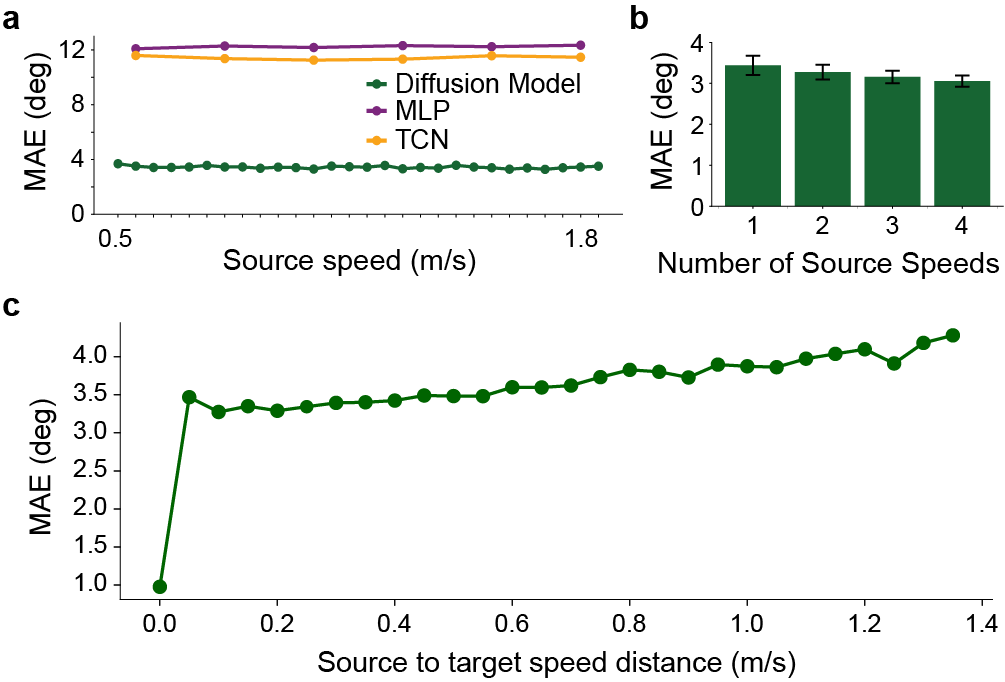
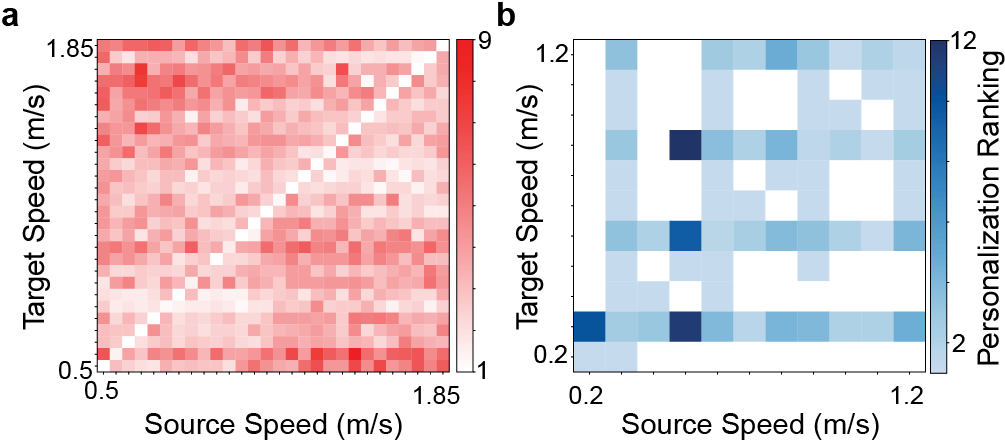
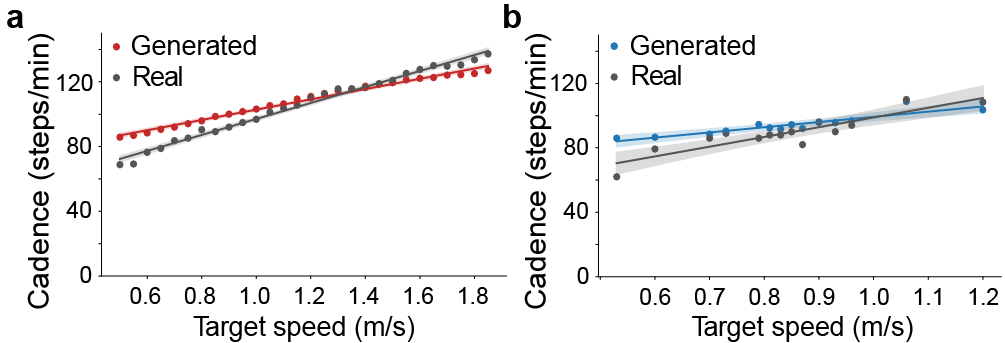
We generate personalized gait kinematics across diverse target speeds from a single source-speed sample using subject-conditioned residual diffusion, which preserves subject-specific gait characteristics.

Architecture

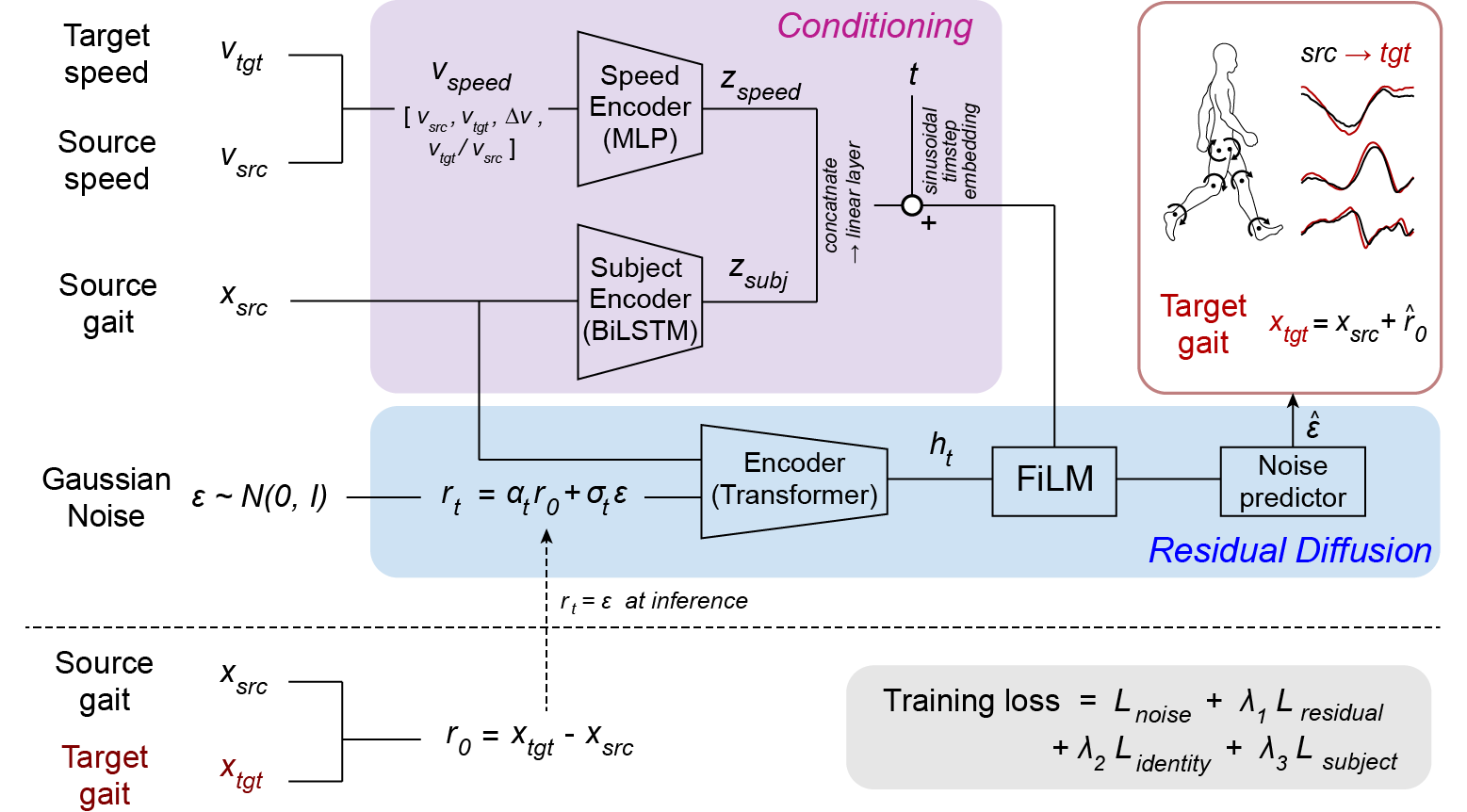
Model architecture diagram

Subject-conditioned residual diffusion framework. Given a source gait trajectory at one walking speed and a desired target speed, the model predicts the residual change needed to synthesize the subject's gait at the target speed. Subject-specific gait features and speed information are used to condition the denoising process, allowing the generated trajectory to preserve individual motion characteristics.
Results

BibTeX


        @misc{dinesh2026generatingpersonalizedlowerlimbkinematics,
          title={Generating Personalized Lower-Limb Kinematics Across Walking Speeds Using Subject-Conditioned Diffusion}, 
          author={Diya Dinesh and Adrian Krieger and Changseob Song and Dongho Park and Aaron J. Young and Inseung Kang},
          year={2026},
          eprint={2607.07533},
          archivePrefix={arXiv},
          primaryClass={cs.RO},
          url={https://arxiv.org/abs/2607.07533}, 
    }